// AI coding practices · observed, not surveyed
See who's actually good with AI. Coach everyone else.
Accrete observes your team's real Claude Code sessions, measures which AI coding practices each engineer has adopted, and shows you exactly what your strongest people do differently — so you can spread it.
Pre-launch. Built on real Claude Code session data — here’s exactly what we see and don’t.
// The picture
Every engineer. Every practice.
One read on how consistently each practice shows up across your team — brighter means more often; the dark cells are where to coach next.
// The problem
You bought the licenses. The usage dashboard says everyone's on board. And that's where your visibility ends.
You can't see who is actually effective with these tools. You can't see what your best people do differently — their sessions look identical to everyone else's in a seat-count chart. And when someone asks "how do we get better at this," the honest answer is an anecdote from whoever spoke last in Slack.
PR counts and DORA metrics don't capture it either. AI coding skill lives inside sessions, and nobody is looking at the sessions.
// How it works
- 01
Capture sessions durably
A small sync client on each developer's machine parses local Claude Code transcripts into a database. The tool purges raw transcripts after about 30 days; Accrete's record persists. Parsed session data — not raw transcript files — syncs to your team's server, one isolated database per company. See how it works and our privacy stance in full.
- 02
Detect practice signals
At ingest, every session is classified: which messages were real human prompts versus tool output, what project the work belongs to, and which concrete practices appeared.
- 03
See the matrix, coach the gap
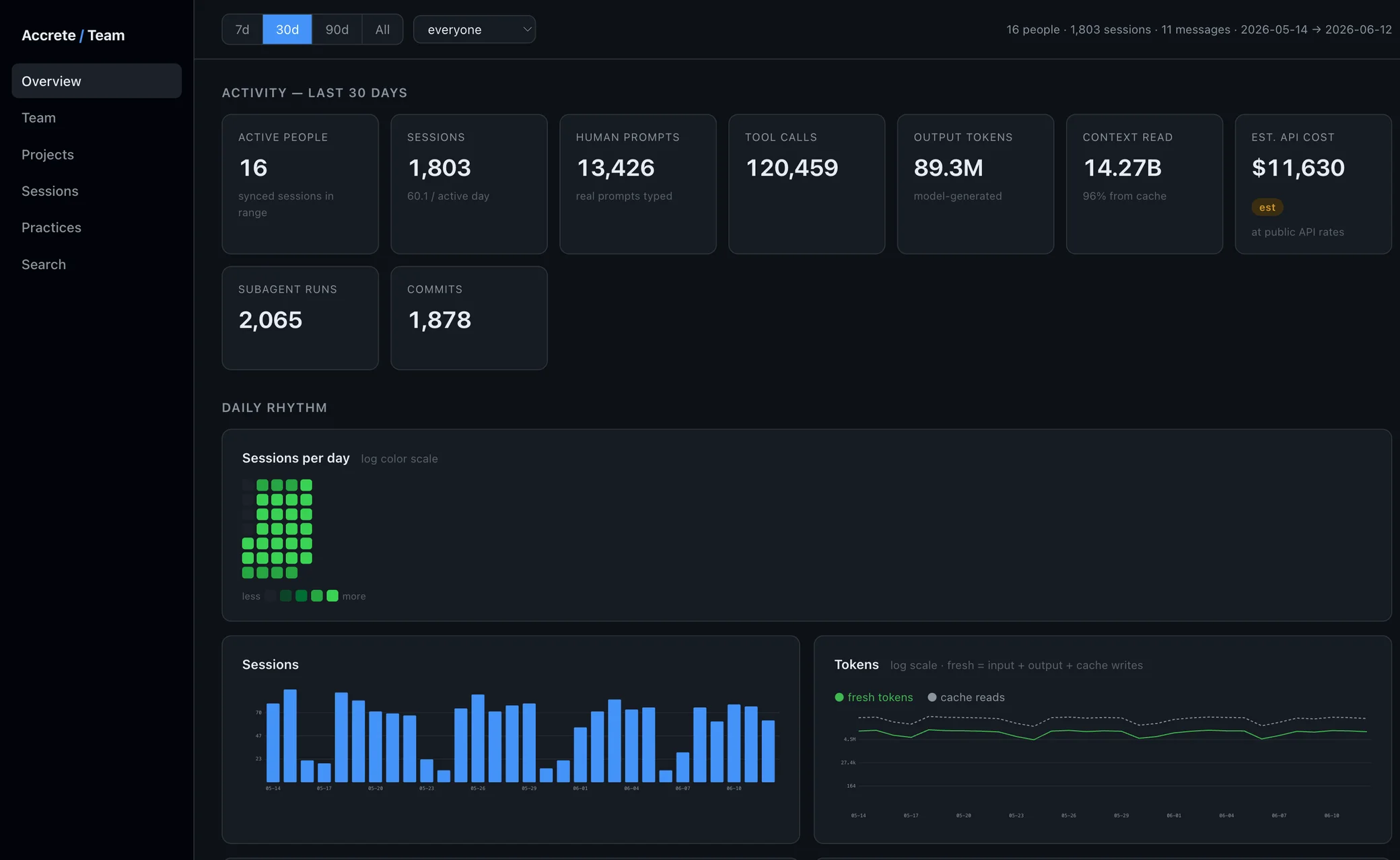
A per-person, per-practice adoption matrix shows who has adopted which practices, who hasn't, and where the team plateaus — the foundation for measuring AI coding impact and coaching your team with evidence.
// The practice catalog
A practice signal is a concrete, detectable behavior in a session — not a survey answer. Examples:
- Planning before coding — using plan mode instead of diving straight in
- Delegating to subagents — splitting work across parallel agents
- Skills and saved commands — reusing proven workflows instead of re-prompting
- Task tracking — keeping the agent on a managed list, not vibes
- Memory and context management — feeding the agent durable project knowledge
- Committing work — sessions that end in shipped commits, not abandoned diffs
A practice counts as adopted per session it appears in; volume is tracked separately. Adoption and proficiency are deliberately distinct — we'd rather measure the difference than blur it. Our guides cover each practice in depth.
// What we believe
You can't coach what you can't see.
Standard metrics miss AI coding skill entirely. Session data makes it observable.
Adoption is not proficiency.
Everyone has a license. Measure the gap between holding the tool and being good with it.
Evidence beats anecdote.
Decisions should run on real session data — the kind we publish from in our research — not the loudest opinion in the room.
We're pre-launch: no public customers, no published benchmarks yet. We'd rather tell you that than imply otherwise.
For engineering leaders
Answer “is it working?” with evidence. Start with measuring AI coding impact and coaching your team.
For individual engineers
Not a leader? Accrete works at the individual level too — see your own practice map, find what stronger sessions look like, and bring it to your team bottom-up. Start with Accrete for engineers.
A note from the founder
I built Accrete because I wanted to see my own AI-coding practice clearly, and I needed evidence — not opinions — to push change on the teams I worked with. The good ways of working were trapped inside individual sessions, invisible to everyone else. Accrete is how they get found and spread.
— Mike, founder
Early access
See what your team's sessions can teach you.
Join the list for an invite when we open up — or deploy on your team as a design partner.